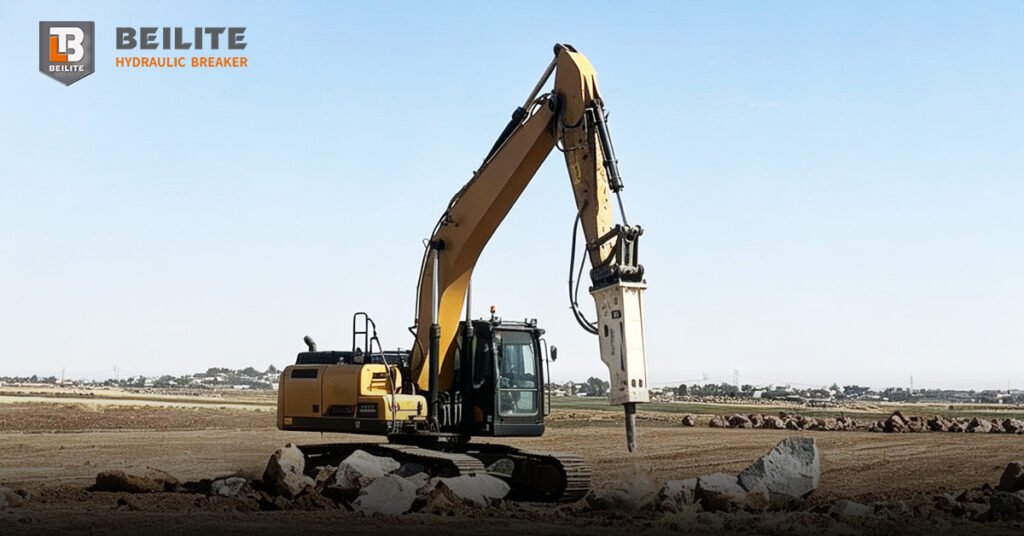
If you operate a 20-ton excavator in South Africa or the Southern SADC region, choosing a hydraulic breaker is not just about finding the biggest hydraulic hammer that will physically fit the machine.
The rock breaker must match the excavator’s operating weight class, hydraulic oil flow, working pressure, attachment weight, chisel diameter, impact rate, and carrier configuration.
For contractors working in demolition, road construction, quarrying, mining, trenching, rock breaking, and infrastructure projects, these details directly affect productivity and operating costs.
For the 20-ton excavator class, the Beilite BLT-140 Silent Hydraulic Breaker is designed for 20 – 24 ton excavators, with a 140 mm chisel diameter, 120 -180 L/min working oil flow, 160 -180 bar working pressure, 350 – 500 bpm impact rate, and 1,910 kg silenced operating weight.
This guide explains what those numbers mean and how to determine whether a silenced breaker is suitable for your excavator in South Africa and Southern SADC markets.
Quick Answer: Which Silenced Breaker Fits a 20-Ton Excavator?
For a typical 20-ton excavator, the Beilite BLT-140 is the relevant silenced breaker model.
| Specification | BLT-140 Silenced Hydraulic Breaker |
| Recommended excavator | 20 – 24 tons |
| Breaker operating weight | 1,910 kg |
| Chisel diameter | 140 mm |
| Chisel length | 1,250 mm |
| Working oil flow | 120 -180 L/min |
| Working pressure | 160 -180 bar |
| Relief pressure | 210 bar |
| Impact rate | 350 – 500 bpm |
| Oil hose size | 1 inch |
| Configuration | Silenced / sound-suppressed |
Why Choose a Silenced Breaker for a 20-Ton Excavator?
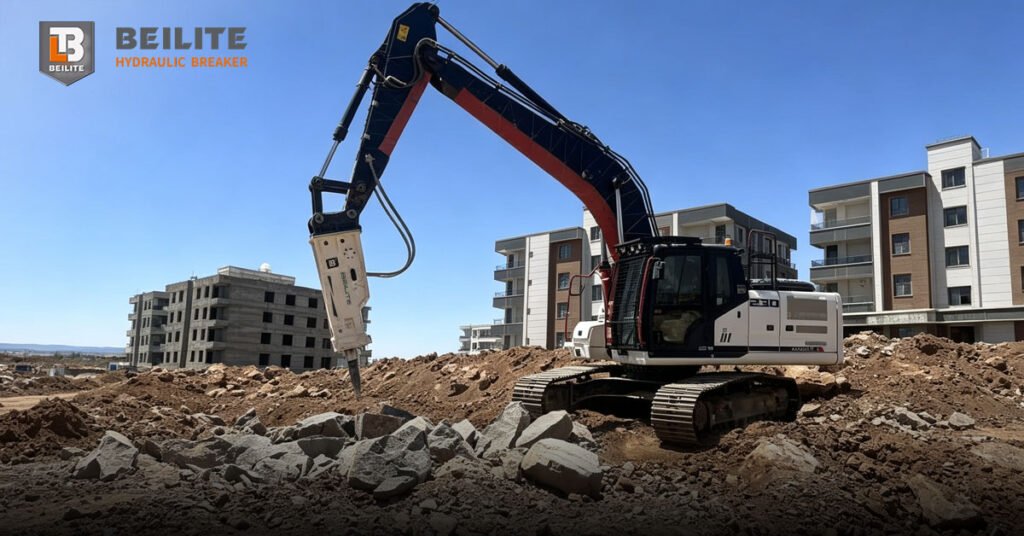
A conventional hydraulic breaker can produce substantial mechanical noise and vibration, particularly when breaking reinforced concrete, hard rock, or road surfaces.
A silenced hydraulic breaker or hydraulic hammer uses an enclosed housing and shock-absorption design to reduce transmitted noise and vibration.
This becomes particularly useful when a 20-ton excavator is working:
- Near residential areas
- In urban demolition
- On road and bridge projects
- Near commercial buildings
- Around hospitals, schools, or public facilities
- In infrastructure maintenance
- On construction sites where noise and vibration are concerns
The BLT-140 uses Beilite’s MIC shock-absorption technology and enclosed housing to reduce operational noise and vibration while protecting the internal breaker components.
For South African contractors, this can make a silenced rock breaker particularly attractive for projects where breaking performance and controlled site disturbance both matters.
BLT-140 Specifications for 20-Ton Excavators
1. Excavator Operating Weight: 20 – 24 Tons
The first number to check is the carrier weight class.
The BLT-140 is specified for excavators in the 20 – 24 ton range.
This means a 20-ton excavator is within the intended carrier class, while excavators outside that range require a separate compatibility assessment.
Do not select a breaker solely because the excavator manufacturer describes the machine as “20 ton”.
Two excavators with similar operating weights can have different:
- Auxiliary hydraulic flow
- Hydraulic pressure
- Boom and arm dimensions
- Mounting arrangements
- Hydraulic connections
- Counterweight configurations
- Stability characteristics
The carrier’s actual hydraulic and mechanical specifications should therefore be checked before installation.
Why hydraulic breaker weight matters?
The BLT-140 silenced version weighs approximately 1,910 kg.
That weight becomes part of the excavator’s working attachment load.
An attachment that is too heavy for the carrier can affect:
- Machine stability
- Lifting capacity
- Boom and arm loading
- Working reach
- Fuel consumption
- Operator control
The correct breaker is therefore not necessarily the heaviest breaker available. It is the breaker that provides the required breaking performance without exceeding the carrier’s hydraulic and structural capabilities.
2. Hydraulic Oil Flow: 120 – 180 L/min
Hydraulic flow is one of the most important specifications when buying a breaker.
The BLT-140 requires a working oil flow of: 120 -180 L/min
with a working pressure of: 160 – 180 bar.
The excavator’s auxiliary hydraulic circuit must be capable of supplying the breaker within its required operating range.
What happens if the oil flow is wrong?
If flow is too low, the rock breaker may not achieve its intended operating performance.
If flow is too high without proper hydraulic control, the breaker can be exposed to excessive flow, heat, or pressure.
For this reason, operators should not simply connect a hydraulic breaker to an available auxiliary line and assume it will work correctly.
Before purchasing, check:
Excavator auxiliary flow → Breaker required flow → Excavator pressure → Breaker working pressure
The hydraulic circuit should be adjusted according to the excavator and breaker manufacturer’s requirements.
3. 140 mm Chisel Diameter
The BLT-140 uses a: 140 mm diameter chisel
with a published chisel length of: 1,250 mm.
Chisel diameter is more than a product number. It gives an indication of the breaker size and the type of work for which the attachment is designed.
For a 20-ton excavator, a 140 mm tool provides a substantial working size for applications such as:
- Concrete demolition
- Road breaking
- Foundation removal
- Rock excavation
- Quarry work
- Secondary rock breaking
- Trenching
- General infrastructure demolition
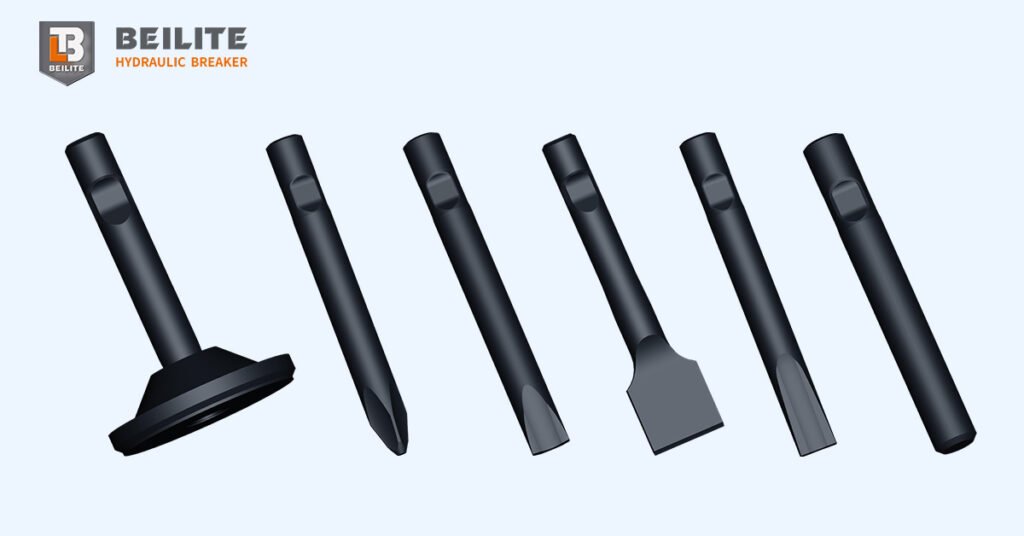
The correct tool profile should also be selected according to the material and application.
4. Impact Rate: 350–500 BPM
The BLT-140 has an impact rate of: 350–500 blows per minute (bpm).
Impact frequency describes how many times the breaker strikes during one minute of operation.
A higher BPM does not automatically mean a breaker is better.
The best impact rate depends on the material being broken.
Hard rock
Hard, compact rock may require a different operating approach from softer concrete or fractured material.
Concrete
Breaking reinforced or heavily compacted concrete requires consistent impact performance and correct operator technique.
Road surfaces
For asphalt and concrete pavement, controlled impact can help maintain productivity while limiting unnecessary damage to the carrier.
The operator should allow the breaker to work rather than continuously forcing the excavator’s boom into the material.
5. Working Pressure: 160-180 Bar
The BLT-140’s published working pressure is:160 -180 bar
with a relief pressure of: 210 bar
Pressure and flow must be considered together.
A breaker is a hydraulic attachment, so its performance depends on the complete hydraulic circuit rather than pressure alone.
When installing the breaker, the hydraulic system should be checked for:
- Correct pressure setting
- Correct oil flow
- Proper return line requirements
- Hydraulic oil condition
- Hose size
- Quick coupler compatibility
- Auxiliary valve configuration
The BLT-140 uses a 1-inch oil hose connection according to the published specifications.
6. Carrier Compatibility: What Excavators Can Use a BLT-140?
The BLT-140 is designed for the 20 -24-ton excavator class.
Published compatible examples include excavators from major manufacturers such as:
- Caterpillar, Komatsu, SANY, XCMG, Volvo
- Hitachi, Doosan, Hyundai, Kobelco, Liebherr
- Case, Sumitomo, JCB, LiuGong
However, model compatibility should never be determined by excavator model name alone.
The same excavator model may have different configurations depending on:
- Market
- Year
- Arm length
- Hydraulic package
- Auxiliary valve
- Quick coupler
- Boom configuration
Always confirm the exact machine configuration before ordering.
20-Ton Excavator Hydraulic Breaker: What Should Buyers Check?
If you are purchasing a hydraulic breaker in South Africa, Botswana, Namibia, Zambia, Zimbabwe, Mozambique, Lesotho, Eswatini, or another Southern African market, use this checklist.
Carrier
Is the excavator within the 20 -24 ton recommended range?
Hydraulic Breaker weight
Can the excavator safely carry the approximately 1,910 kg silenced attachment?
Hydraulic flow
Can the auxiliary circuit provide 120–180 L/min?
Hydraulic pressure
Does the circuit operate within the 160–180 bar working range?
Chisel
Is a 140 mm tool suitable for the material and production requirement?
Impact rate
Is 350–500 bpm appropriate for the application?
Mounting
Does the breaker mounting bracket match the excavator arm and pin dimensions?
Hoses
Are the hydraulic hoses and fittings correctly sized and rated?
Service
Are seals, tool components, nitrogen charging, hydraulic hoses and other wear parts available when required?
This checklist can prevent a common purchasing mistake: selecting a breaker based only on excavator tonnage.
Silenced Hydraulic Breakers for South Africa
South Africa has a broad construction, mining, quarrying, demolition, road-building, and infrastructure market.
That means contractors can encounter very different breaking conditions—from concrete structures and road rehabilitation to hard rock and quarry applications.
A 20-ton excavator equipped with a correctly matched silenced breaker can provide a practical combination of:
Carrier mobility
- Breaking productivity
- Controlled vibration
- Reduced operational noise
- Attachment versatility
- Easier transport between projects
For contractors working in built-up areas, the sound-suppressed design can be particularly useful where reducing noise and vibration is an important project consideration.
Beilite’s South African product range includes silenced breakers and publishes local specifications for the 20 – 24 ton BLT-140 class.
Read Next Blog: Hydraulic Breakers for Southern SADC Markets
Submit Request Quote ->
Beilite South Africa Supplier Contacts
Tel: +27 646876799
WhatsApp: +27 646876799
Email: [email protected]