SADC officially consists of 16 Member States, including South Africa, Botswana, Eswatini, Lesotho, Malawi, Mozambique, Namibia, Zambia, Zimbabwe, Angola, Tanzania, Madagascar, Mauritius, Seychelles, Comoros, and the Democratic Republic of the Congo.
For this article, the focus is specifically on South Africa and the southern SADC markets, where contractors commonly require hydraulic attachments for construction, mining, quarrying, roadwork, demolition, and infrastructure projects.
Read this blog: Silenced Breakers for 20 -Ton Excavators
Silenced Breakers for 20 -Ton Excavators for for Southern SADC Markets
South Africa
- Typical applications include:
- Urban demolition
- Road construction
- Quarrying
- Mining
- Concrete breaking
- Infrastructure maintenance
Botswana
A correctly matched 20-ton excavator breaker can be used for construction, trenching, rock breaking, and infrastructure work, subject to the carrier’s hydraulic configuration.
Namibia
For contractors working around construction and hard-ground applications, hydraulic flow and carrier stability are particularly important when selecting a breaker.
Zambia
Mining, quarrying, construction, and infrastructure projects can require breakers capable of sustained operation. Correct hydraulic matching becomes especially important for production work.
Zimbabwe
Hydraulic breakers can support demolition, roadwork, quarrying, construction, and rock excavation applications where excavator-mounted breaking is more practical than manual or separate breaking equipment.
Mozambique
Construction, infrastructure, quarrying, and development projects may require excavator-mounted hydraulic breakers. Buyers should consider both attachment specifications and local service support.
Eswatini and Lesotho
Compact project sites, road construction, civil works, and infrastructure maintenance can benefit from a breaker matched correctly to the carrier.
Malawi
For construction, roadwork, quarrying, and civil engineering applications, the correct hydraulic flow and attachment weight remain key purchasing considerations.
The important point across these markets is the same:
Do not buy a hydraulic breaker because it is advertised as a “20-ton breaker.” Match the complete hydraulic and mechanical specifications to the excavator.
BLT-140 vs. Larger Hydraulic Breakers
One of the easiest mistakes is choosing a breaker that is too large.
Beilite’s published range shows a clear progression:
| Rock Breaker | Excavator class | Silenced weight | Chisel | Flow | Impact rate |
| BLT-140 | 20 -24 t | 1,910 kg | 140 mm | 120 -180 L/min | 350 – 500 bpm |
| BLT-155 | 27- 33 t | 2,610 kg | 155 mm | 180 -240 L/min | 200 – 300 bpm |
| BLT-165 | 33 – 38 t | 3,149 kg | 165 mm | 200 – 260 L/min | 150 – 300 bpm |
| BLT-175 | 36 – 45 t | 4,575 kg | 175 mm | 210 – 260 L/min | 130 – 200 bpm |
| BLT-195 | 50 – 60 t | 5,420 kg | 195 mm | 260 -310 L/min | 100 -140 bpm |
For a 20-ton excavator, the BLT-140 sits in the manufacturer’s intended 20 – 24 ton carrier class.
Why Breaker Weight and Oil Flow Must Be Matched Together?
For Example Consider two breakers:
Hydraulic Breaker (A)
- 1,910 kg
- 120 -180 L/min
- 140 mm chisel
- 20 -24 ton carrier
Rock Breaker (B)
- 5,420 kg
- 260–310 L/min
- 195 mm chisel
- 50 – 60 ton carrier
Rock Breaker B is considerably larger, but that does not make it a better attachment for a 20-ton excavator.
The excavator must provide the hydraulic capacity and structural stability required by the attachment.
This is why professional hydraulic breaker selection starts with the carrier, not the hammer.
What Is the Best Silenced Breaker for a 20-Ton Excavator?
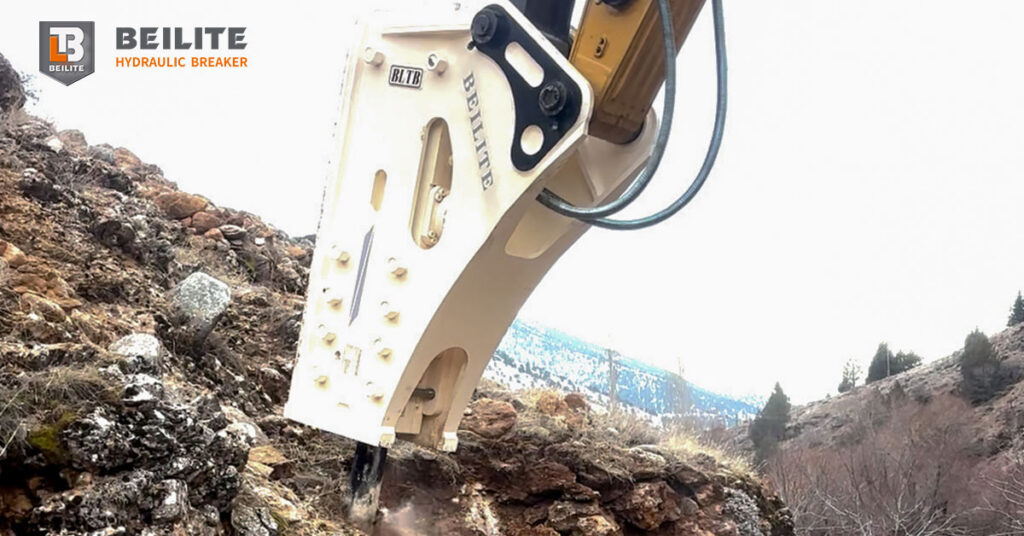
For the Beilite range, the BLT-140 Silent Hydraulic Breaker is the model specified for 20 – 24 ton excavators.
Its key specifications are:
- 1,910 kg silenced weight
- 140 mm chisel
- 120 -180 L/min oil flow
- 160 -180 bar working pressure
- 350 -500 bpm impact rate
- 20 – 24 ton carrier class
- inch hydraulic hose
- 1,250 mm chisel length
For buyers in South Africa and Southern SADC markets, the final selection should then be confirmed against the exact excavator model, hydraulic package, mounting dimensions, and intended application.
How to Choose a 20-Ton Excavator Breaker for Mining or Quarrying?
Mining and quarrying are generally more demanding than light construction.
Before purchasing, consider:
Rock hardness
Hard, competent rock requires a breaker and tool configuration capable of handling repeated high-impact work.
Production requirement
If the breaker will operate for long periods, hydraulic cooling capacity and correct flow become increasingly important.
Carrier stability
The excavator must remain stable while positioning the breaker and applying force.
Tool selection
The chisel or working tool should match the material and breaking method.
Maintenance support
Mining and quarrying operations cannot afford unnecessary downtime. Spare parts, seals, tools, accumulators, hydraulic hoses, and technical support should therefore be considered before purchase.
How to Choose a 20-Ton Breaker for Demolition?
Demolition has different priorities.
For urban demolition, buyers may place greater emphasis on:
- Noise reduction
- Vibration control
- Operator visibility
- Precise positioning
- Concrete breaking performance
- Service accessibility
This is where a silenced hydraulic breaker can provide an advantage over a conventional open-frame design.
For larger structural demolition, the breaker should still be selected according to the concrete thickness, reinforcement, structure, access, and excavator configuration.
Common Mistakes When Buying a Hydraulic Breaker
Mistake 1: Matching only by excavator tonnage
“20-ton excavator” does not tell you the complete hydraulic specification.
Always check flow and pressure.
Mistake 2: Choosing the largest breaker
A heavier breaker is not automatically more productive.
The attachment must be appropriate for the carrier.
Mistake 3: Ignoring breaker operating weight
The breaker becomes part of the excavator’s working load.
Mistake 4: Ignoring hydraulic oil flow
Incorrect flow can result in poor performance or hydraulic problems.
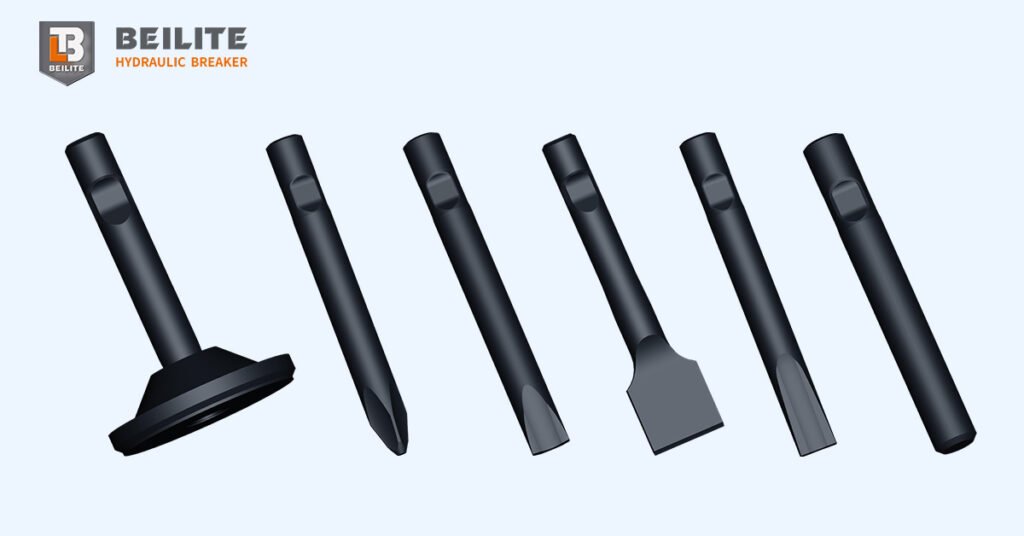
Mistake 5: Selecting the wrong chisel
Tool diameter and configuration should match the application.
Mistake 6: Buying without checking mounting dimensions
The breaker must physically and hydraulically connect to the excavator.
Mistake 7: Forgetting after-sales support
For professional contractors, parts availability and technical support can be as important as the initial purchase price.
20-Ton Hydraulic Breaker Buying Checklist
Before ordering a silenced hydraulic breaker, confirm these 10 points:
- Excavator operating weight
- Auxiliary hydraulic flow
- Working pressure
- Relief pressure
- Breaker operating weight
- Chisel diameter
- Impact rate
- Mounting and pin dimensions
- Hydraulic hose and fitting size
- Spare parts and service availability
If all ten points are compatible, the breaker is much more likely to deliver reliable field performance.
Frequently Asked Questions
What size hydraulic breaker do I need for a 20-ton excavator?
A rock breaker designed for the 20 – 24 ton excavator class is the appropriate starting point. Beilite’s BLT-140 is specified for 20 – 24 ton excavators.
What is the oil flow requirement for a 20-ton BLT-140 breaker?
The BLT-140 requires 120–180 L/min of working hydraulic oil flow. Its published working pressure is 160–180 bar.
What is the chisel size of the BLT-140?
The BLT-140 uses a 140 mm diameter chisel with a published length of 1,250 mm.
How many blows per minute does the BLT-140 produce?
The published impact rate is 350–500 blows per minute (bpm).
How much does a BLT-140 silenced breaker weigh?
The published silenced configuration weighs approximately 1,910 kg.
Is a silenced breaker suitable for South Africa?
Yes. A silenced hydraulic breaker can be useful for demolition, construction, infrastructure, and other applications where controlling operational noise and vibration is important. Beilite’s South African range includes silenced hydraulic breakers for different excavator classes.
Can the BLT-140 work on any 20-ton excavator?
Not automatically. The excavator must meet the required hydraulic flow, pressure, mounting, and stability requirements. Beilite lists multiple compatible excavator models, but final compatibility should be confirmed using the exact carrier configuration.
Is the BLT-140 suitable for mining and quarrying?
It can be used for rock breaking and mining-related applications, but suitability depends on the rock type, production requirement, operating conditions, and excavator configuration. For heavier production requirements, a larger breaker/carrier class may be more appropriate.
Final Buying Advice for South Africa & Southern SADC
When buying a silenced hydraulic breaker for a 20-ton excavator, do not start with the question:
How powerful is the hydraulic breaker?
Start with:
Does the breaker match my excavator?
For the Beilite BLT-140, the key figures are straightforward:
20 – 24 ton excavator | 1,910 kg silenced weight | 140 mm chisel | 120–180 L/min oil flow | 160–180 bar working pressure | 350–500 bpm impact rate.
That combination makes the BLT-140 a relevant hydraulic breaker option for contractors operating 20-ton-class excavators across South Africa and Southern SADC markets.
For the final selection, verify the excavator’s auxiliary hydraulic specifications, mounting dimensions, carrier stability, and application requirements before ordering.
Need to match a breaker to a specific excavator? Provide the excavator brand and model, and the required hydraulic flow and pressure can be checked against the breaker specifications before purchase.
Read this blog: Silenced Breakers for 20-Ton Excavators
Submit Request Quote ->
Beilite South Africa Supplier Contacts
Tel: +27 646876799
WhatsApp: +27 646876799
Email: [email protected]